

If you roster overnight support in an NDIS home, the SCHADS sleepover allowance is one of the easiest entitlements to get wrong — and one of the most expensive when you do. Under the Social, Community, Home Care and Disability Services Industry Award (MA000100), a sleepover attracts a flat allowance of $62.87 per night from the first full pay period on or after 1 July 2026, on top of pay for any active work the worker performs during the night. That figure follows the Fair Work Commission's 4.75% Annual Wage Review increase for 2026–27.
This guide explains what a sleepover actually is under clause 25.7, how the 2026 changes reshaped the way sleepovers interact with shifts, and exactly what you must pay so your payroll stands up to scrutiny. Every figure here should be confirmed against the current Fair Work Ombudsman Pay Guide for MA000100 before you load it into payroll, because allowance amounts move with each annual wage review.
What is a sleepover under the SCHADS Award?
A sleepover occurs when an employer requires a support worker to sleep overnight at a workplace or a participant's home so they are available to provide care if needed during the night. The defining feature is that the worker is permitted to sleep — they are not expected to be actively working for the whole period. If the worker is awake and working through the night, that is an active overnight shift, not a sleepover, and it must be paid as ordinary or overtime hours with the relevant penalties.
Clause 25.7 sets out the conditions. The employer must provide a separate room with a bed and clean linen, access to food-preparation and bathroom facilities, and free board and lodging for the night. The sleepover span is a continuous period of around eight hours. Get any of these conditions wrong and the arrangement may not qualify as a sleepover at all — which can convert the whole night into paid working time.
How much is the SCHADS sleepover allowance in 2026?
The sleepover allowance is set at 4.9% of the standard rate under the award. In dollar terms that is approximately $62.87 per night from the first full pay period on or after 1 July 2026. The percentage basis has not changed; the dollar figure rose with the 2026–27 Annual Wage Review (a 4.75% increase to SCHADS minimum rates).
Two points trip providers up repeatedly:
- The allowance is flat, not hourly. The $62.87 covers the requirement to be present and available for the night. It is not a per-hour rate.
- Active work is paid separately. If the worker is woken to perform duties, that time is paid at the applicable rate — with a minimum payment of one hour of overtime — and is not absorbed by the flat allowance. Treating the allowance as covering call-outs is a common and costly error.
The allowance forms part of ordinary time earnings, so superannuation applies to it, and it is included in gross wages for tax and Single Touch Payroll reporting.
What changed for sleepovers in 2026
The 2026 SCHADS variation did not change the dollar value of the allowance, but it changed how a sleepover interacts with the shifts around it — and that has real payroll consequences.
- A sleepover no longer counts as a break between shifts. Under the amended clause 25.4, where an employee works immediately before and after a sleepover, those periods and the sleepover form part of the same continuous shift rather than being separated by the 10-hour rest rule.
- Extended shifts by agreement. Consistent with the new framework (clause 28.1(b)(iii)), part-time and casual employees may work up to 12 hours in a shift that includes a sleepover without automatically attracting overtime, where the appropriate agreement is in place.
- Penalties still assess per period. The active work before and after the sleepover is still assessed for shift and weekend penalties on its own merits, even though the whole thing is one shift for overtime and span purposes.
The practical upshot: one shift for overtime and span, but two separate assessments for penalty loadings. For the broader picture of how loadings, broken shifts and overtime fit together, see our guide to SCHADS penalties, broken shifts and sleepovers explained.
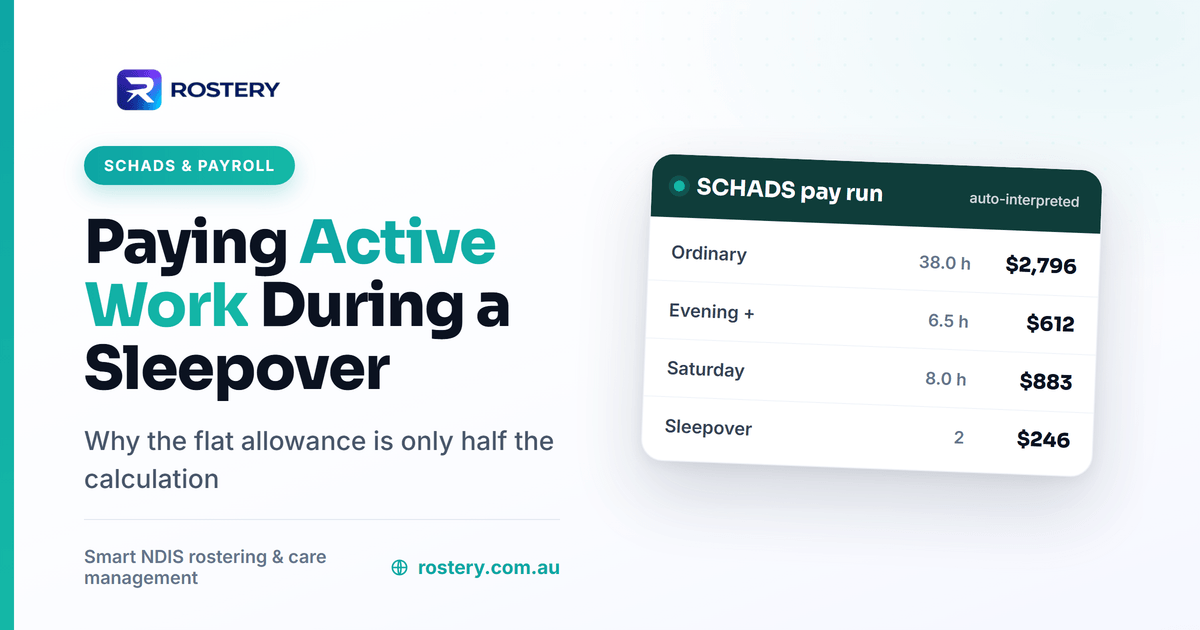
Paying active work during a sleepover
This is where most underpayment claims originate. Clause 25.7(e) requires that if a worker on a sleepover is required to perform work, they are paid at the prescribed overtime rate for the time worked, with a minimum payment as for one hour. Where the work exceeds one hour, it is paid at the overtime rate for the actual duration.
Worked example for a single weeknight sleepover:
- Worker is rostered for a sleepover: pay the $62.87 allowance for the night.
- Worker is woken at 2:00am and works for 20 minutes: pay a minimum of one hour at the overtime rate, not 20 minutes.
- Worker is woken again at 4:30am and works for 90 minutes: pay 1.5 hours at the overtime rate (another disturbance, assessed on its own).
- Rostered active work before and/or after the sleepover must be paid for a minimum of four hours at the applicable rate.
Weekend and public holiday penalties still apply to the active work performed — a sleepover on a Sunday does not turn Sunday-rate work into weekday-rate work.
Minimum engagement and the four-hour rule
Where a worker performs rostered work immediately before or after a sleepover, at least one of those periods of active work must be rostered (or paid) for a minimum of four hours. This minimum-engagement protection prevents providers from bookending a sleepover with tiny paid slivers of active time. When you build overnight rosters, the safest pattern is a clearly defined active block, the sleepover span, and then a defined active handover block — each documented against the roster.
Common sleepover payroll mistakes (and how to avoid them)
- Treating the flat allowance as covering call-outs. Every disturbance is separately payable at overtime with a one-hour minimum.
- Calling an active overnight shift a “sleepover”. If the worker is awake and working, it is a shift — pay it as such.
- Skipping the facility requirements. No proper sleeping room, bed and linen means the arrangement may not qualify as a sleepover.
- Missing weekend/public holiday penalties on active work. The allowance never absorbs penalty rates.
- Using last year's figure. The allowance rose to $62.87 for 2026–27; confirm the current amount each 1 July.
Manual interpretation of these interacting clauses is where errors creep in at scale. Rostery's SCHADS-aware payroll and rostering engine applies the sleepover allowance, minimum-engagement rules and per-period penalties automatically as you build the roster, so overnight support is costed correctly before the pay run — not corrected after an underpayment claim. You can also sanity-check individual scenarios with our free SCHADS pay calculator.
A quick checklist for compliant sleepovers
- Confirm a separate room, bed, clean linen and facilities are provided.
- Pay the current sleepover allowance ($62.87 per night for 2026–27).
- Record and pay every active-work disturbance separately (min one hour, overtime rate).
- Roster at least one four-hour active block before or after the sleepover.
- Apply weekend/public holiday penalties to active work performed.
- Treat the sleepover and adjoining work as one continuous shift for span and overtime.
- Re-check the allowance dollar figure against the Fair Work Pay Guide every 1 July.
Frequently Asked Questions
How much is the SCHADS sleepover allowance in 2026?
Approximately $62.87 per night under MA000100 from the first full pay period on or after 1 July 2026, equal to 4.9% of the standard rate. Confirm the exact current figure against the Fair Work Ombudsman Pay Guide, as allowance amounts change with each Annual Wage Review.
Is active work during a sleepover paid separately?
Yes. Any time the worker is woken to perform duties is paid at the overtime rate with a minimum payment of one hour — and any applicable weekend or public holiday penalties still apply. It is not absorbed by the flat allowance.
Does a sleepover count as a break between shifts?
No. From the 2026 variation, clause 25.4 means a sleepover no longer counts as a break between shifts. The work immediately before and after it forms one continuous shift with separate active-work periods.
Do I have to provide a bed and a private room for a sleepover?
Yes. Clause 25.7 requires a separate room with a bed and clean linen, access to food-preparation and bathroom facilities, and free board and lodging. Without these, the arrangement may not qualify as a sleepover.
Can a worker do 12 hours including a sleepover without overtime?
Under the 2026 framework, part-time and casual employees may work up to 12 hours in a shift that includes a sleepover without automatically attracting overtime, where the appropriate agreement is in place. Always check the current award wording for your stream.


